MDB selection hospital rooms in Saudi Arabia requires meticulous planning and adherence to electrical standards to ensure uninterrupted power supply and patient safety. ECS KSA, an ISO 9001:2015 certified manufacturer with 15+ years serving the region, specializes in delivering switchgear to over 30+ countries, including healthcare projects in Riyadh. This system must support critical equipment with a minimum fault rating of 50 kA, complying with IEC 60947-6-1 to guarantee secure operation amid electrical faults. Understanding these requirements is essential for proper electrical panel implementation.
Key Criteria for MDB Technical Specifications
Defining electrical load requirements in hospitals
In Jeddah's hospital environments, accurately determining the electrical load is critical for selecting a main distribution board that supports diverse medical apparatus. The load profile includes ventilators, diagnostic imaging devices, and computer systems, which demand continuous power without interruption. The MDB must accommodate a peak load capacity often surpassing 3000 Amps, allowing flexibility for future expansions while maintaining compliance with IEC 60947-2 standards for circuit breakers. Proper load assessment reduces risk of overloads and enhances system reliability, a vital factor in healthcare settings where uptime is crucial.
Material quality and rated current considerations
The choice of materials directly impacts the durability and efficiency of an MDB system deployed in hospital rooms. In Eastern Province healthcare facilities, switchgear components must satisfy stringent resistance criteria to ambient temperature levels exceeding 45°C, ensuring continuous performance even under harsh environmental conditions. Copper busbars with ratings above 4000 Amps offer superior conductivity and lower losses, while panel enclosures require at least IP54 protection to guard against dust and water ingress. Incorporating these attributes ensures longevity and operational safety, critical for sensitive medical applications that demand 24/7 availability.
Selecting IEC 61439 compliance features
Compliance with IEC 61439, which governs low-voltage switchgear and control gear assemblies, is non-negotiable for hospital MDBs in Saudi Arabia due to its assurance of safety and performance. These regulations specify requirements for enclosure protection, insulation coordination, and thermal withstand capability. In hospitals located in Dammam, adherence to these standards translates into switchgear products that have undergone rigorous testing for dielectric strength and short-circuit withstand capability. ECS KSA's products meet IEC 61439 criteria, making them suitable for medical environments where operational continuity is paramount. Among the tested features, the adherence also includes conformity to SASO specifications, enhancing GCC regional acceptance. This section links to MDBs for hospital power distribution as an example of compliant solutions.
Ensuring Compliance with Saudi Regulations
Meeting SASO standards for hospital switchgear
Adhering to Saudi Standards, Metrology and Quality Organization (SASO) guidelines is essential for electrical panels serving hospitals in Medina. SASO mandates certification for electrical equipment that ensures safety, electromagnetic compatibility, and energy efficiency. These standards require switchgear to be tested for current interrupting capacity in alignment with IEC 60947-2, corroborating their capability to handle fault currents typically rated up to 50 kA. Complying with SASO not only secures regulatory approval but also mitigates risks to hospital patients and personnel, especially where severe power fluctuations could compromise medical interventions.
SEC grid code impact on MDB design
The Saudi Electric Company (SEC) grid code imposes direct influences on switchgear configurations in hospitals across Al Khobar by specifying voltage stability and harmonic distortion thresholds. These requirements compel MDBs to incorporate protective relays and harmonic filters compliant with SEC limits. The code stipulates the need for selective coordination among circuit breakers, improving fault isolation and power restoration. Therefore, switchboards must feature interrupting capacities aligned with grid fault levels reaching 35 kA. The SEC guidelines complement the IEC standards by tailoring them to Saudi power infrastructure nuances.
Incorporating safety and testing protocols
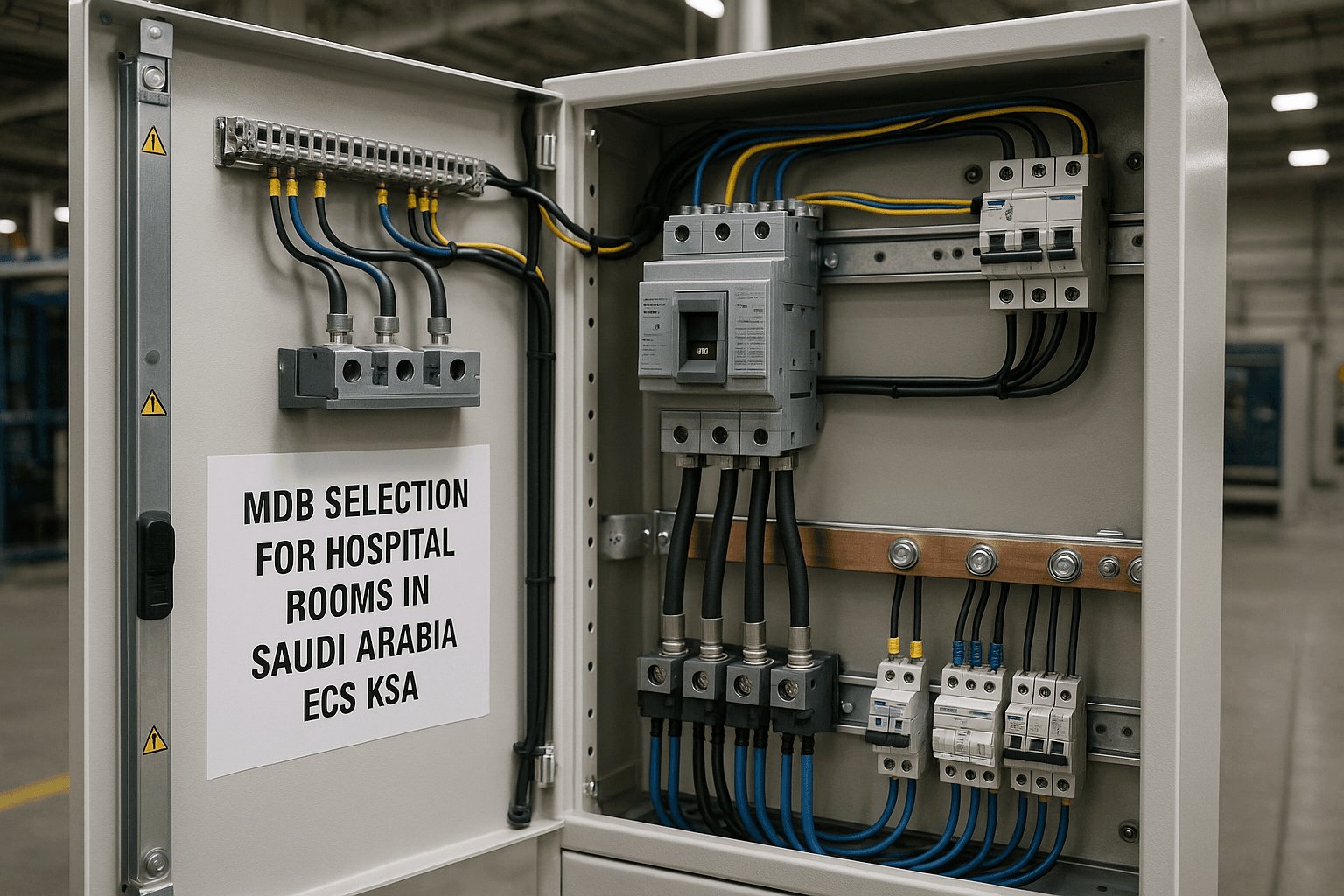
Comprehensive safety measures are non-negotiable to mitigate electrical hazards in hospital environments, particularly in protected isolation wards in Tabuk. Testing protocols include performing insulation resistance tests, high potential (Hi-Pot) tests, and functional operation checks for all protective devices within the MDB. Frequency of testing aligns with IEC 61439 recommendations, ensuring MTBF values exceed healthcare standards. Implementing these protocols supports not only compliance but also the continuous safe delivery of power. ECS KSA’s switchgear integrates these stringent checks, reflected in MDB hospital room power distribution systems widely adopted in Saudi medical facilities.
Comparing Distribution Board Types for Hospitals
Advantages of metal-clad versus sheet steel panels
In Riyadh’s healthcare facilities, selecting metal-clad panels offers superior protection compared to conventional sheet steel enclosures. Metal-clad units provide enhanced electrical insulation, increased mechanical strength, and superior heat dissipation, which is essential where ambient temperatures may surpass 45°C. Additionally, these panels possess higher kA fault ratings, up to 65 kA, allowing more robust fault current interruption in critical areas. Their construction supports IP65 rating, ensuring resistance against dust ingress and water jets, an advantage in hospital zones requiring sterile and controlled atmospheres.
Functionality differences between MCCBs and MCBs
Molded Case Circuit Breakers (MCCBs) and Miniature Circuit Breakers (MCBs) serve distinct roles in Saudi hospital power distribution. MCCBs, suited for main feeders and larger branch circuits, can handle current ratings up to 2500 Amps and interrupt fault currents exceeding 50 kA, assuring reliable fault protection. In contrast, MCBs are designed for smaller loads, typically below 100 Amps, and provide rapid response to overloads in localized circuits such as lighting and outlet systems within patient rooms. Utilizing both appropriately enhances overall electrical safety and flexibility, precisely tailoring the MDB system to various load demands.
Choosing appropriate transfer switch integration
Automatic Transfer Switches (ATS) and Manual Transfer Switches (MTS) are integral for ensuring power continuity in hospital electrical rooms in KSA. ATS units rapidly switch load to emergency generators within seconds of main supply failure, crucial in intensive care settings where downtime must be minimized. These switches comply with IEC 60947-6-1, validating their effectiveness under high fault conditions up to 63 kA. Manual switches offer cost efficiency for less critical zones but require operator presence. Selection hinges on the criticality of hospital areas, with ATS preferred for life-supporting systems to meet stringent reliability requirements.
Recommended Installation Procedures
Case Study: Jubail Medical Center Power Factor Correction
At Jubail Medical Center, a critical healthcare facility in the Eastern Province, ECS KSA implemented a 1600A power factor correction (PFC) panel to improve operational efficiency aligned with Saudi Vision 2030 objectives promoting energy sustainability. Before installation, the hospital’s power factor was at a suboptimal 0.74, leading to high reactive power penalties. After deploying the customized ECS KSA switchgear panels designed to IEC 60947-6-1 and compliant with SASO 2035 standards, the power factor improved significantly to 0.97. This upgrade reduced monthly energy costs by 18%, while enhancing equipment lifespan. Meeting these standards ensures ongoing compliance with national electrical codes and supports the facility’s push towards more sustainable energy usage in line with KSA’s vision for healthcare infrastructure modernization.
Linking MDB Selection to Saudi Vision 2030 Healthcare Expansion
In response to Saudi Arabia’s Vision 2030 directives emphasizing healthcare sector growth and infrastructure modernization, MDB systems must deliver reliability and scalability. The Vision targets a 35% increase in healthcare facility capacity by 2030, necessitating refined electrical distribution designs. ECS KSA’s ISO 9001:2015 certified switchgear, engineered for high fault ratings and robust thermal management, addresses these demands comprehensively. Hospitals in Riyadh and neighboring cities benefit from switchgear compliance with IEC standards such as IEC 61439, ensuring seamless integration with future smart building technologies. Incorporating these advanced MDB configurations supports wider KSA gigaprojects by improving energy efficiency and reducing downtime, crucial for critical healthcare infrastructures.
Best Practices for Hospital MDB Installation and Commissioning
Hospital MDB installation requires precise attention to site conditions and commissioning protocols. Optimizing space in electrical rooms involves correctly sizing MDB enclosures to allow easy access for maintenance, while preserving clearance per SASO and IEC guidelines. Proper earthing practices with low resistance connections and secure copper busbar joints are crucial for safety and operational stability. In regions with ambient temperatures above 45°C, selecting enclosures with IP54 or higher rating guarantees panel protection against dust ingress and moisture. Commissioning steps include insulation resistance tests, thermal imaging to detect hotspots, verifying protective relay settings, and coordinating with uninterruptible power supplies (UPS). These procedures ensure the MDB’s readiness to power vital hospital systems efficiently. ECS KSA switchgear panels regularly follow these industry best practices, providing dependable power solutions tailored specifically for medical applications.
Frequently Asked Questions
How do SASO regulations affect hospital MDB specifications?
SASO regulations mandate that hospital MDBs comply with strict safety, electromagnetic compatibility, and energy efficiency standards. The regulations require certification for products to ensure they can safely interrupt fault currents commonly rated at 50 kA or higher. Meeting SASO requirements ensures that the MDB performs reliably under fault conditions, minimizing risk to critical hospital equipment and personnel. Furthermore, adherence to these regulations facilitates seamless integration with Saudi Arabia’s electrical grid and guarantees regulatory acceptance for healthcare projects.
What is the ideal MDB rating for critical care units?
Critical care units require MDBs with high current ratings, often exceeding 2500 Amps, and short-circuit withstand ratings of 50 kA or greater. These ratings ensure sufficient capacity to power life-support equipment and emergency systems with no interruptions. Additionally, the MDB must provide selective coordination between circuit breakers to isolate faults quickly, preventing widespread outages. Choosing an MDB with adequate rating safeguards critical medical processes and aligns with IEC and SASO standards for reliability in medical environments.
Can automatic transfer switches improve hospital power reliability?
Automatic Transfer Switches (ATS) significantly enhance power reliability by swiftly switching to emergency power sources during supply failures. In hospitals, this rapid transfer prevents critical equipment downtime, especially in operating rooms and ICUs. ATS devices are engineered to meet IEC 60947-6-1 standards ensuring fault current interruption capability of up to 63 kA. Their integration reduces manual intervention and accelerates power restoration, crucial in medical settings where uninterrupted electricity is vital for patient safety.
What maintenance schedule is recommended for hospital MDBs?
Hospital MDBs require regular maintenance at least twice yearly to ensure optimal performance and safety. This includes cleaning dust accumulation, inspecting busbars and connections for corrosion or thermal damage, and testing protective devices such as MCCBs and relays. A thorough insulation resistance test should also be conducted annually. This planned maintenance minimizes downtime risk and prolongs equipment lifespan, critical for maintaining consistent power in sensitive healthcare environments.
Conclusion
The selection process for mdb selection hospital rooms hinges on understanding load characteristics, stringent compliance with IEC and SASO standards, and choosing appropriate materials and components. Meeting these technical standards enhances safety, ensures reliable power supply, and supports advanced healthcare requirements across Saudi Arabia. ECS KSA’s expertise in crafting IEC-compliant switchgear tailored to healthcare facilities underpins the success of hospital electrical infrastructure. Contact ECS KSA for a free project assessment and custom main distribution board quotation.
Ready to Power Your Industrial Expansion?
ECS KSA delivers ISO 9001:2015 certified electrical solutions, from MDB assemblies to ATS panels, across Saudi Arabia. Our engineers size, build, and commission switchgear to IEC and SASO standards for your exact project requirements.
Get a Free Quote